Claude Opus vs Sonnet vs Haiku: Which Model for Which Job?
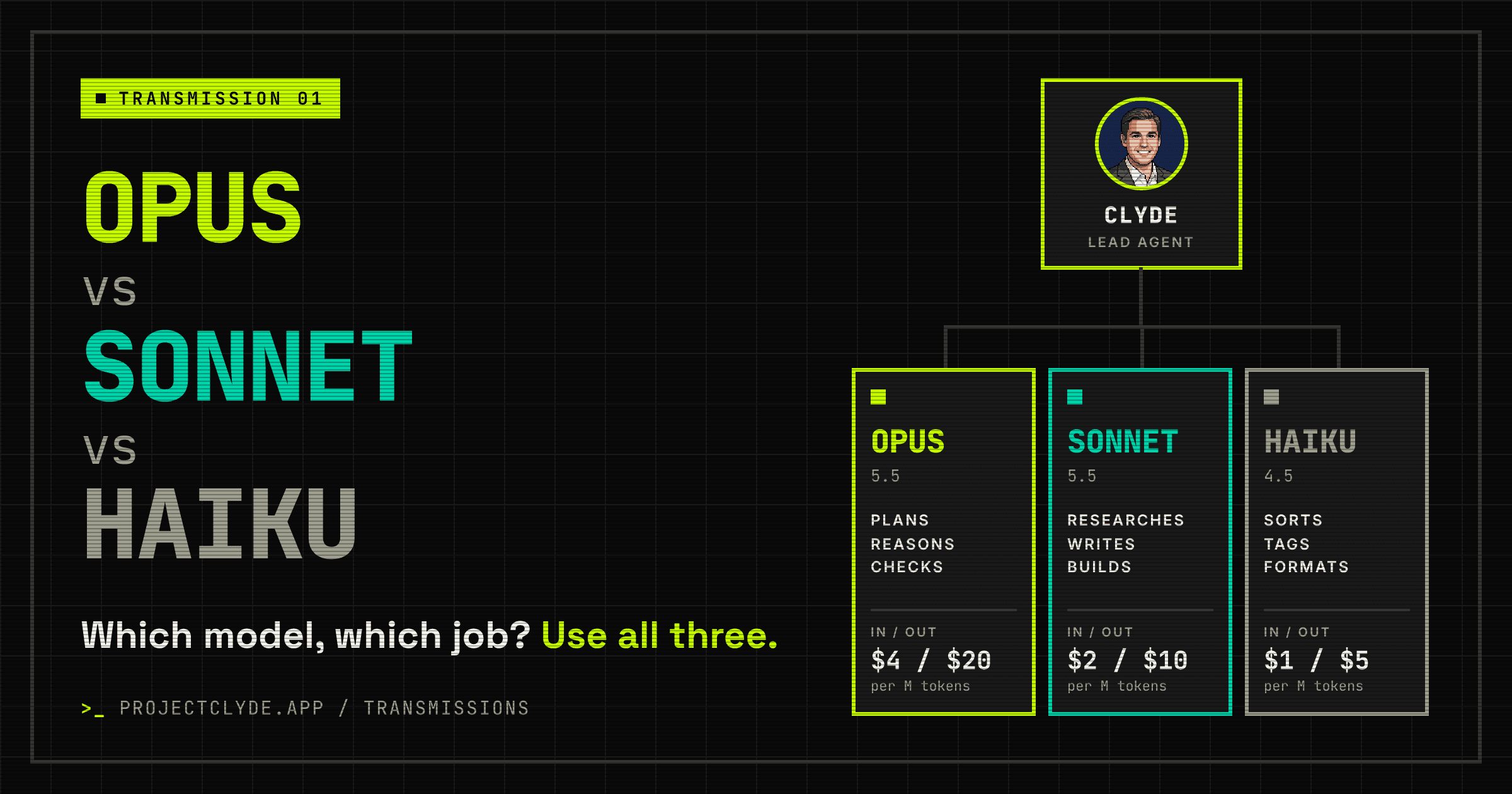
Short answer: use Opus 5.5 when the job needs real thinking (planning, tricky reasoning, long multi-step work), Sonnet 5.5 for most everyday tasks where you want speed and smarts, and Haiku 4.5 for fast, high-volume, simple jobs. Opus costs twice as much as Sonnet and four times as much as Haiku. So the cheapest way to get great results usually isn't picking one. It's using all three, each on the job it's best at.
I get asked this all the time, and it's a big part of why every agent in Clyde gets its own model. Most people pick one model and use it for everything. That means you're either paying Opus prices for jobs Haiku could do in its sleep, or asking Haiku to do jobs it was never built for. Let's fix that.
The three models side by side
| Opus 5.5 | Sonnet 5.5 | Haiku 4.5 | |
|---|---|---|---|
| Input price (per million tokens) | $4 | $2 | $1 |
| Output price (per million tokens) | $20 | $10 | $5 |
| Context window | 1M tokens | 1M tokens | 200K tokens |
| Max output | 128K tokens | 128K tokens | 64K tokens |
| Anthropic describes it as | Long-running agentic coding and knowledge work | Best combination of speed and intelligence | Fastest model with near-frontier intelligence |
Prices and specs from Anthropic's models overview, October 2026. There's also Fable 5.1 above Opus ($10/$50) for the really demanding reasoning work, but for most businesses Opus is the top end you'll actually need.
What that means in real money
Take a typical task: you hand the model a 20,000-token brief (around 15,000 words of notes, emails and docs) and get back a 2,000-token answer.
- Opus 5.5: about 12 cents
- Sonnet 5.5: about 6 cents
- Haiku 4.5: about 3 cents
Cents per run doesn't sound like much. But run that 50 times a day and Opus costs you around $180 a month, while Haiku costs around $45. If Haiku would have done the job just as well, that's money for nothing.
Which model for which job
Use Opus 5.5 when the job needs thinking:
- Planning a piece of work and breaking it into steps
- Tricky reasoning, like a proposal, a strategy or a tough client email
- Long, multi-step tasks where one wrong turn early on wrecks the result
- Checking and editing other models' work
Use Sonnet 5.5 for the everyday heavy lifting:
- Writing first drafts of articles, posts and emails
- Research summaries and pulling insight out of long documents
- Most coding and automation work
- Anything where you want a good answer fast and don't need Opus-level depth
Use Haiku 4.5 for fast, repetitive jobs:
- Sorting, tagging and classifying (emails, leads, support tickets)
- Pulling data out of documents into a set format
- Short summaries and quick replies
- Anything you run hundreds of times a day
Why the real answer is "all three"
Here's the thing nobody tells you. The best results don't come from the smartest model. They come from the right model on each step.
Think of it like a small business. You wouldn't pay your most senior person to file invoices, and you wouldn't ask your newest hire to write the strategy. You'd have a lead who plans and checks, a couple of solid people who do the bulk of the work, and someone quick on the admin.
AI works exactly the same way:
- Opus plans the job and decides who does what
- Sonnet does the research and the writing
- Haiku handles the quick, repetitive bits
- Opus checks the final output before it reaches you
You get Opus-level quality where it matters and Haiku prices everywhere else. That's exactly what Clyde does: you chat to one lead agent, and it hands each part of the job to a specialist running on the right model.
The honest limitation: splitting work across agents adds a bit of overhead, so for a one-off quick question, just ask Sonnet directly. A team pays off when the job has several distinct steps or you run it regularly.
Try it: the Content Crew
FAQ
Is Claude Opus better than Sonnet?
Opus 5.5 is stronger on long, complex, multi-step work and hard reasoning. Sonnet 5.5 is faster, half the price, and plenty for most everyday tasks. "Better" depends on the job, which is why mixing them works so well.
Is Claude Haiku good enough for business tasks?
For fast, repetitive jobs like sorting emails, tagging leads, pulling data out of documents and short summaries, yes. It's a quarter of Opus's price. For planning or nuanced writing, step up to Sonnet or Opus.
Which Claude model is the cheapest?
Haiku 4.5, at $1 per million input tokens and $5 per million output tokens. Sonnet 5.5 is $2/$10 and Opus 5.5 is $4/$20 (October 2026).
Which Claude model is best for coding?
Sonnet 5.5 handles most coding work well. Anthropic positions Opus 5.5 for long-running agentic coding, where the model works through a big task over many steps.
Can I use Opus, Sonnet and Haiku together?
Yes. Multi-agent tools like Clyde let each agent run on a different model, so a lead agent on Opus can plan and check while Sonnet and Haiku agents do the bulk of the work.
Over to you
Which model are you using for everything right now, and what would you hand to Haiku tomorrow? I'd love to hear what you're building.
Noel Tovey-Grindlay is the founder of Clyde. 20+ years in engineering, from the Royal Navy to defence and space programmes, now building multi-agent AI for small businesses.
Sources
- Claude models overview, Anthropic (pricing, context windows and positioning, checked 7 Oct 2026)